

This article was first published in the magazine Spellcraft the ‘definitive guide to Magick in the Southern Hemisphere’…. but serves pretty well as a ‘womanifesto’ for my work at the yOniversity and my comic cabaret Vaudeville of the Vulva.
I am a collector (and a purveyor) of Vulva Art. My home is adorned with sumptuous silk and velvet vulva pillows, fluffy vulva purses, vulva pens, vulva jewellery and more. Some people are shocked when they see my collection, some are delighted but most ask “Why?”. I tell them that I believe the vulva is a wondrous and magical place, worthy of the utmost respect and the most beautiful artistic representations. Anyone who has witnessed the natural entry of a child into this world would find it hard to deny the incredible qualities of the vulva. From a purely physical perspective her ability to stretch to accommodate the head of the newborn is nothing short of awe inspiring. Alas few of us have had the privilege to attend such a moving and fundamental event. This was not always the case. Respect for the as the portal between the worlds was widespread in ancient times. And so was Vulvic Art.
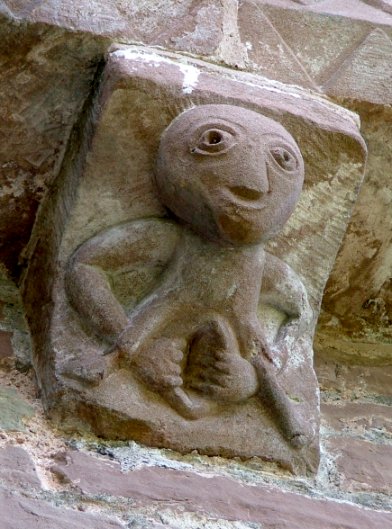 Sheila na Gigs (or Sheelah-na-Gigs) are figurative carvings of naked women displaying an exaggerated vulva. They are found on churches, castles and other buildings, particularly in Ireland and Britain.
In the prestigious Encyclopedia of Religion, (Eliade, Mircea. (Editor),1987) there are references to Sheila na Gigs
“The obvious life-giving and growth-promoting powers of the vulva and its secretions have given rise to a widespread use of representations of the female genitalia as apotropaic (intended to “ward off evil”) devices. …. An apotropaic function seems to have prompted the placing of squatting female figures prominently exposing their open vulvas on the key of arches at church entrances in Ireland, Great Britain, and German Switzerland…. Most such figures were removed from churches in the nineteenth century.”
And a little farther down in the same article:
“A remarkable parallel to the Celtic Sheelagh-na-gig is found in the Palauan archipelago. The wooden figure of a nude woman, prominently exposing her vulva by sitting with legs wide apart and extended to either side of the body, is placed on the eastern gable of each village’s chiefly meeting house. Such figures are called dilugai … These female figures protect the villagers’ health and ward off all evil spirits as well. They are constructed by ritual specialists according to strict rules, which if broken would result in the specialist’s as well as the chiefs death. It is not coincidental that each example of signs representing the female genitalia used as apotropaic devices are found on gates. The vulva is the primordial gate, the mysterious divide between nonlife and life”
(Encyclopedia of Religion, article YONI, Vol.15, p.534).
I believe that much healing can be achieved through reclaiming the magic of the vulva in our modern world. However, to do so we need first to inspect our current cultural attitudes to this most glorious and sacred part of the body. Not only do we have no respectful representations of the vulva, many of us are uncomfortable even talking about her. Last year the Weekend Australian ran an article about three US students who were suspended from high school for disobeying teachers and uttering the word “vagina” during a reading from the Eve Ensler’s Vagina Monologues.
I suggest that it is of the utmost importance to investigate and work towards healing any disempowering attitudes we have had foisted onto us about our most glorious and sacred feminine parts. By doing so women will feel better about themselves, boost their self-esteem, reduce depression and increase respect for the feminine in our society. There are three simple steps we can take to start to reclaim the magic of the vulva.
We can use vulvic imagery as a powerful talisman. This need not be overt. The mandorla and even the V, or the cleft V are time honoured symbols for the vulva and can easily be incorporated into jewellery, art or even scribbles on a post-it note!
We can practice using her name. It may take time to become comfortable but it is unlikely to happen unless we start.
And thirdly, if we were lucky enough to be born in a woman’s body, we can kegel. Anywhere, any time! And while that enigmatic Mona Lisa smile creeps over our faces we can affirm the wonder and the power of feminine nature.a